
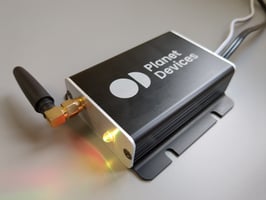
Track heat pump performance with the Internet of Things Powered by integrated Pebl, PlanetData...
The New 14x14mm IoT Gateway for Makers
Integrated Pebl enables you to seamlessly connect the board of your dreams to the Internet of Things.
The integrated Pebl possesses all of of Pebl One's capabilities, with some notable differences.
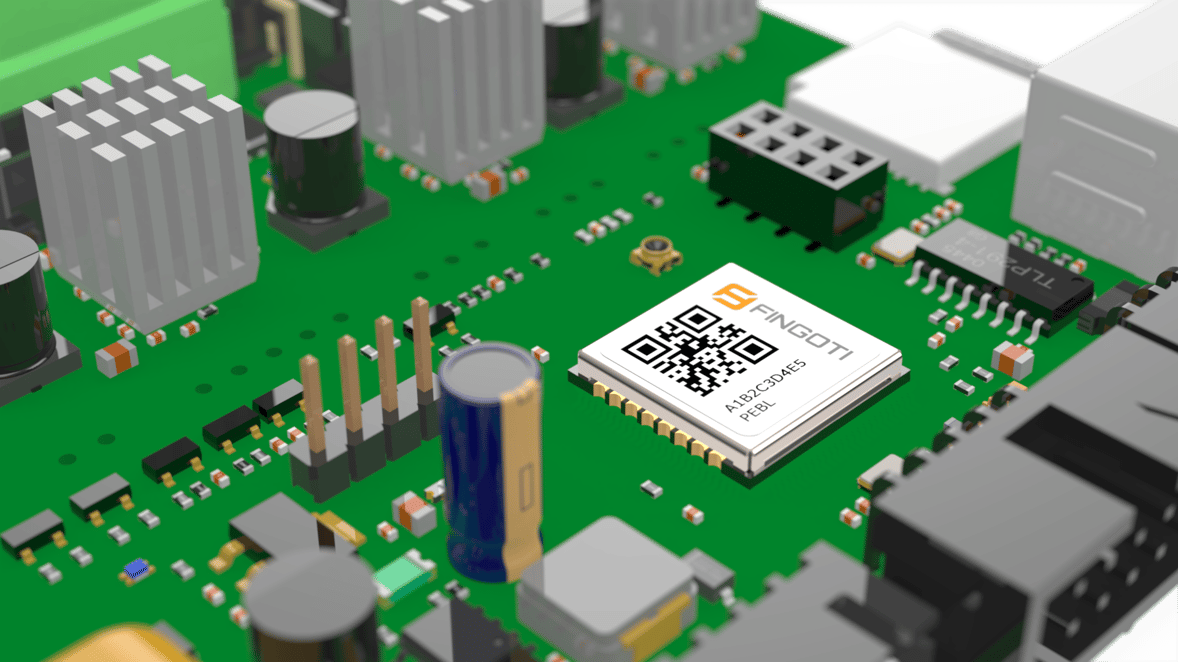
What's new?
More ways to claim
- Connect over Bluetooth
- Scan a QR code
Integrated Pebl features a new processor, allowing us to offer Bluetooth communication for the first time on Pebl. Owing to its diminutive size, integrated Pebl forgoes the NFC chip found on Pebl One.
| Bluetooth | QR Code | NFC | WiFi | Serial (UART) | Web Browser | |
| Pebl One | ❌ | ❌ | ✔️ | ✔️ | ✔️ | ✔️ |
| Integrated Pebl | ✔️ | ✔️ | ❌ | ✔️ | ✔️ | ✔️ |
.png?width=1920&height=1080&name=Breakout_Breadboard%20(2).png)
Double the I/O
Pebl One has four GPIO pins available at all times, whether you need them or not. The two pins reserved for TX/SDA, and RX/SCL, mean that only one communication protocol (UART or I2C) can be used at any one time.
| Data Bus Pin 1 | Data Bus Pin 2 | GPIO 1 | GPIO 2 | GPIO 3 | GPIO 4 | |
| UART | TX | RX | ✔️ | ✔️ | ✔️ | ✔️ |
| I2C | SDA | SCL | ✔️ | ✔️ | ✔️ | ✔️ |
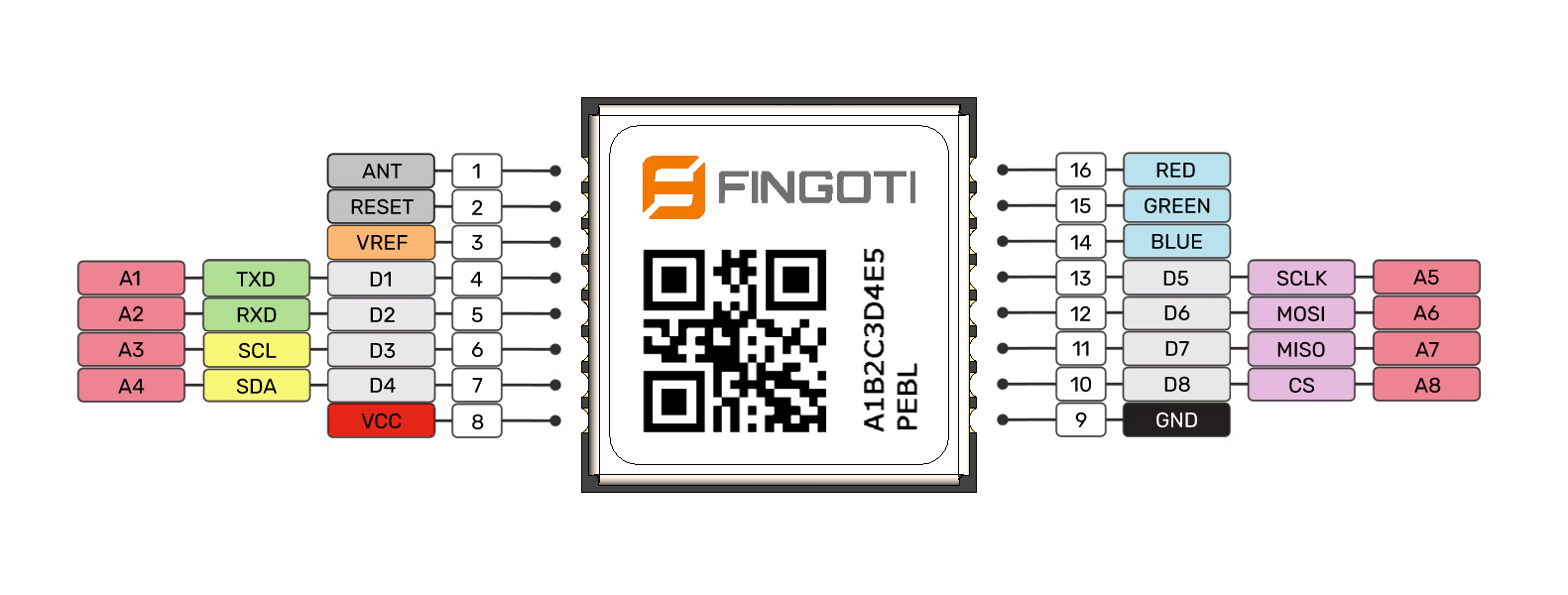
By contrast, integrated Pebl provides eight configurable I/O pins. The user can choose between UART, I2C, GPIO, and - in another first - SPI. By default, I2C, UART, and SPI are available concurrently, meaning there are no pins available for GPIO.
- By disabling I2C or UART, you gain two GPIO pins each
- By disabling SPI, you gain four GPIO pins
| I2C (IO1, IO2) | UART (IO3, IO4) | SPI (IO5, IO6, IO7, IO8) | Available GPIOs | |
| All Buses Enabled | ✔️ | ✔️ | ✔️ | 0 |
| All Buses Disabled | ❌ | ❌ | ❌ | 8 |
| I2C Only | ✔️ | ❌ | ❌ | 6 |
| UART Only | ❌ | ✔️ | ❌ | 6 |
| SPI Only | ❌ | ❌ | ✔️ | 4 |
| I2C and UART | ✔️ | ✔️ | ❌ | 4 |
| I2C and SPI | ✔️ | ❌ | ✔️ | 2 |
| UART and SPI | ❌ | ✔️ | ✔️ | 2 |
| IO1 | RX |
| IO2 | TX |
| IO3 | SCL |
| IO4 | SDA |
| IO5 | SCLK |
| IO6 | MOSI |
| IO7 | MISO |
| IO8 | CS |
Differences from Pebl One
RF antenna
Integrated Pebl requires a 2.4Ghz, 50Ω antenna for WiFi and Bluetooth communication. The breakout board features an onboard antenna, and uFL SMT antenna connector - for use with an external antenna.
The new processor incorporates RF coexistence; WiFi and Bluetooth can be used simultaneously, over a single antenna.
Device LED
Integrated Pebl does not include a device LED. You can provide your own LED and use the RGB pins provided. The following endpoints can still be used:
-
deviceActivity
-
deviceBlink
-
deviceColour
Power supply
Where Pebl One accepted between 3-16V input, integrated Pebl accepts 3.3V only. Power regulation and voltage smoothing - à la Pebl One - must be implemented by the maker.
Technical specifications
Processor
- Dual-core
- 32-bit
- 240MHz
Wireless
- 2.4GHz 802.11b/g/n WiFi @ 21dBm
- 2.4GHz Bluetooth 5 / Low Energy (LE)
Power (Input)
- 3v3
- ~60mA
Connections
- I2C (Inter-Integrated Circuit)
- UART (Universal Asynchronous Receiver/Transmitter)
- SPI (Serial Peripheral Interface)
- MQTT
- HTTP (Hypertext Transfer Protocol)
- HTTPS (Hypertext Transfer Protocol Secure)
- WS (WebSockets)
GPIO (Output)
- 3v3
- 28mA (Sync)
- 40mA (Drive)
LED
- Three channel (RGB)
- 28mA (Sync)
- 40mA (Drive)
ADC
- 12-bit
- Automatic averaging
External voltage monitor (VREF)
- 24v (max)